Tuesday, September 24, 2013

Reynolds-shmeynolds! All Steel Frames Are Alike.

For the longest time, I naively believed that one steel framed bike was pretty much like any other. I saw the bike frame merely as something on which you hang the components. I figured a cheap old frame with nice wheels and Dura Ace or Super Record components would beat the pants off of a high-end steel frame with a mediocre component gruppo and wheels.

Sure, I knew the old frames built with the top Reynolds, Columbus and Tange tube sets were a bit lighter, and were highly coveted by experienced riders. Weight matters to a certain degree, but the frame alone is far less than half of the total weight of a complete bike. And as far as being highly coveted, I figured those poor saps doing the coveting were just victims of marketing and hype.

I've slowly been outgrowing that belief over the past few years, but I recently had a massive growth spurt when I had the opportunity to compare two bikes that were very similar in every way except for the tubing they were built with. Remember that racy Trek 560 that I bought a couple of years ago? I loved riding that bike, but finally came to the conclusion that it was a size too small for me. So, I put all of the original parts back on it and put it up for sale on Craigslist.

The plan was to replace it with another Trek 560 of the right size once I sold it. Serendipitously something even better came up on Craigslist almost immediately after I sold the 560.

Say hello to my "new" 1985 Trek 760.


When I bought the Trek 760 its original Campy Victory parts were long gone. The guy I got it from had bought it as a bare frame and built it up with a mostly meh assortment of early 90s Japanese components. I decided to strip it bare and rebuild it with all of the parts that had been on the Trek 560. This gave me a rare opportunity to compare two frames with the exact same components so I could get a good feel for the differences between the frames.

So, with the 760 rebuilt the differences between the two bikes came down to this:
  • The 760 is a size bigger than the 560 (the 760 is a size 56cm, and the 560 is a size 21" or 53.34cm)
  • There are slight differences in geometry between the two models.
  • The 760 is built with Reynolds 531C tubing while the 560 is Reynolds 501.

The size and geometry differences look like this (the 560's numbers are in the red box in the top section and the 760's are in the lower red box):


The head tube angle is a fair amount steeper on the 760, but other than that differences are either attributable to the different sizes (i.e. the 760 has a longer top tube and seat tube), or they are extremely small and probably not significant.

So what about the difference in tubing? How is Reynolds 531C different than Reynolds 501? According to the 1985 Trek brochure, there are differences in tube wall thickness.


The top tube's walls are thinner, the down tube's are a little thicker and the seat tube's are thinner in 531C as compared to 501 tube set. There are also differences in how the tubes are manufactured and the composition of the steel, but those differences supposedly have little impact on the strength or ride quality of the finished bike. There's some weight difference in the tube sets, but the difference is negligible when it comes to a fully built bike. Both bikes weigh about 22 lbs ready to ride with peddles and everything.


On paper this all looks pretty trivial to my inexperienced eye. I expected these two bikes to ride very similarly. I doubted that I would even be able to tell them apart in a blindfold test. Not that I would ever try riding blindfolded!

So, the next Saturday morning after building up the 760, I went for a good long ride...


By the way, I had ridden the 560 just a week before so its ride quality and handling characteristics were still pretty fresh in my mind. I rode 70 or so miles on some of my favorite roads that day with lots of ups, downs, twists, turns, smooth pavement, rough pavement and even a bit of gravel.

The difference between the 760 and my beloved old 560 was mind-blowing!

As I've said before, I loved the ride of that 560. Everything about it was quick and precise. When you jumped on it, it took off. The downside was that you could feel every pebble and crack in the pavement, and the handling required constant attention.


On the 760 I instantly noticed a smoother and more stable ride. There was little of the jarring and buzzing that I had come to associate with the 560. The ride quality was more like my Cadillac-like Trek 614 than it was like the 560. And the handling of the 760 had all of the quickness and precision of the 560, but with less effort and attention required. I never felt like I was having to force it into a tight turn. The handling was more intuitive and invisible than on any other bike I had ever ridden.

Talking about ride quality and handling characteristics of bikes is a little like wine reviews. It can be a lot of meaningless hyperbole that is really just trying to say either "I like this" or "I don't like this." So rather than try to use up a bunch more words explaining my perceptions, I'll just say this: I found my new Trek 760 to feel very different than my old 560, and I really liked the difference.


Since that first Saturday ride, I've ridden the new 760 a few hundred more miles. I'm still a bit blown away every time I get on it. It's by far the best riding bike I've ever owned. It has very clearly taught me that one lugged steel frame is not like another, even if they may look very similar on paper.

What accounts for the differences? I'm still not sure. It could be attributed to the different tube sets, but I suspect it's more complicated than that. That's one of the things I love about bikes. They are amazingly complex for such simple machines.

"Just like women" says a friend of mine.

Monday, August 5, 2013

An Unpaved Adventure Close to Home


This last week someone posted a message on the Seattle Randonneurs Google group saying they would be visiting the Seattle area and asking for suggestions for good gravel road rides while they're in the area. Several members of the group, of course responded with great suggestions. It got me to thinking that my rides have gotten a bit repetitive and boring lately, and I could use a good gravel road adventure to spice things up. So I picked one of the suggested routes that looked interesting and was close to home.

The route had recently been used for a cyclo-cross race and included a mix of paved roads, paved and unpaved multi-use trails, gravel roads and even a few miles of single-track. I didn't really keep track, but I'd guess that about 35 miles of the route were unpaved, and most of the paved sections were very quiet back roads with little or no traffic.


I started early enough that even the Sammamish River Trail was deserted as I passed through Woodinville to the real start of the route near Redmond. Later in the day on my return trip, this stretch of trail would look like WA-520 at rush hour with walkers, joggers, dog-walkers, stroller-pushers, toddling toddlers, roller-bladers, and cyclists all out enjoying the sunny day and competing for trail space.


Apparently the balloonists get an early start. I saw four in the skies over the Sammamish Valley and could hear the roar of their burners as I rode by.


The first couple miles after leaving the trail were on quiet roads, but before long I was on the Power Line trail. In spite of the high voltage lines overhead, there are beautiful stretches of well maintained trail reminiscent of narrow English country lanes.


And then there are other sections that aren't quite as scenic and you're reminded why the trail was here in the first place.


The Power Line trail connects with the Regional Pipe Line trail on Redmond Ridge which offers a couple miles of perfectly maintained twisting and turning single track. The only other bikes I saw out here were mountain bikes, but it was all very rideable on a drop-bar road bike with wide-ish tires.

From the Regional Pipe Line trail I connected with the Tolt Pipeline trail and followed it east of Duvall a few miles before turning off near Lake Joy and following traffic-free gravel roads back into Carnation.


The Snoqualmie Valley trail between Carnation and Duvall is unpaved, but it's so flat and smooth I was able to ride as fast as if I was on brand new pavement.

From Duvall it's a straight shot on the Tolt Pipeline trail back to the Sammamish Valley trail. And when I say straight shot, I mean literally, as the crow flies. The pipeline trail makes one gentle turn to the left between the Snoqualmie Valley and the Sammamish Valley but otherwise makes no attempts to go around or switchback gently when the hills get steep. It goes straight up and and over some wicked hills. I'm sure the pipeline engineers were just being efficient, but it makes for a great workout in the last few miles of the route, and the last descent into the Sammamish Valley is a screamer on a road bike as the trail drops 300' in less than a quarter mile.

I finished the ride feeling like I had had a real adventure, even though for most of the trip I was still within the suburbs and never more than a few miles from a good latte.

Wednesday, July 31, 2013

Brooks Cambium C17 Saddle: The Other New Baby from England

When Brooks announced that 100 lucky cyclist would get to be "beta testers" for their Cambium C17 saddle, I was one of the thousands who clambered to the Brooks website and promptly crashed their server. Unfortunately, I wasn't selected for the test program, but since I signed up for the test program, I was able to get a Cambium at a discount when it finally became available for purchase about a month ago. And after weeks of waiting, I came home this evening to find a promisingly sized box with a familiar logo on my front porch.


I have to say, the packaging was pretty fancy for a stodgy old company like Brooks. The box unfolded like a marketing brochure with every panel assuring me that this saddle was not my father's Brooks.


They even provided a definition of "Cambium" to clear up any possible confusion about the name.


CAMBIUM

(kăm'bē-əm), NOUN, Botany

1. layer of actively dividing cells between xylem (wood) and phloem (bast) tissues that is responsible for the secondary growth of plants.

2. layer of meristematic plant tissue that produces new bark and wood cells, causing the stem or trunk to grow in diameter and forming the annual ring in trees.

That clears up a lot. I always wondered what that was between xylem and phloem.


After unfolding a dizzying number of flaps, eventually I found a very tweedy looking Brooks saddle.


Indeed, the Cambium doesn't look much like traditional Brooks saddles. The top is made of vulcanized rubber bonded to organic cotton.


Since I ordered my Cambium as soon as they came available, mine is part of a limited edition of 1,200 saddles. The limited edition saddles include a series number etched in the front rivet. That's kinda cool, isn't is?


Mine is number 048. Could come in handy if it ever gets stolen and then later turns up on Craigslist, I suppose.


One of the back rivets is etched with the model number. I'm not sure if that's just the limited edition or if they all have that.


The shape is quite different than other Brooks saddles, with a flatter profile from end to end and a fairly rounded profile from side to side. At first glance it looks a lot more like a Selle San Marco Regal than a Brooks B17.


I should appologize for this next photo as it looks a little like something Anthony "Carlos Danger" Weiner would tweet to his friends.


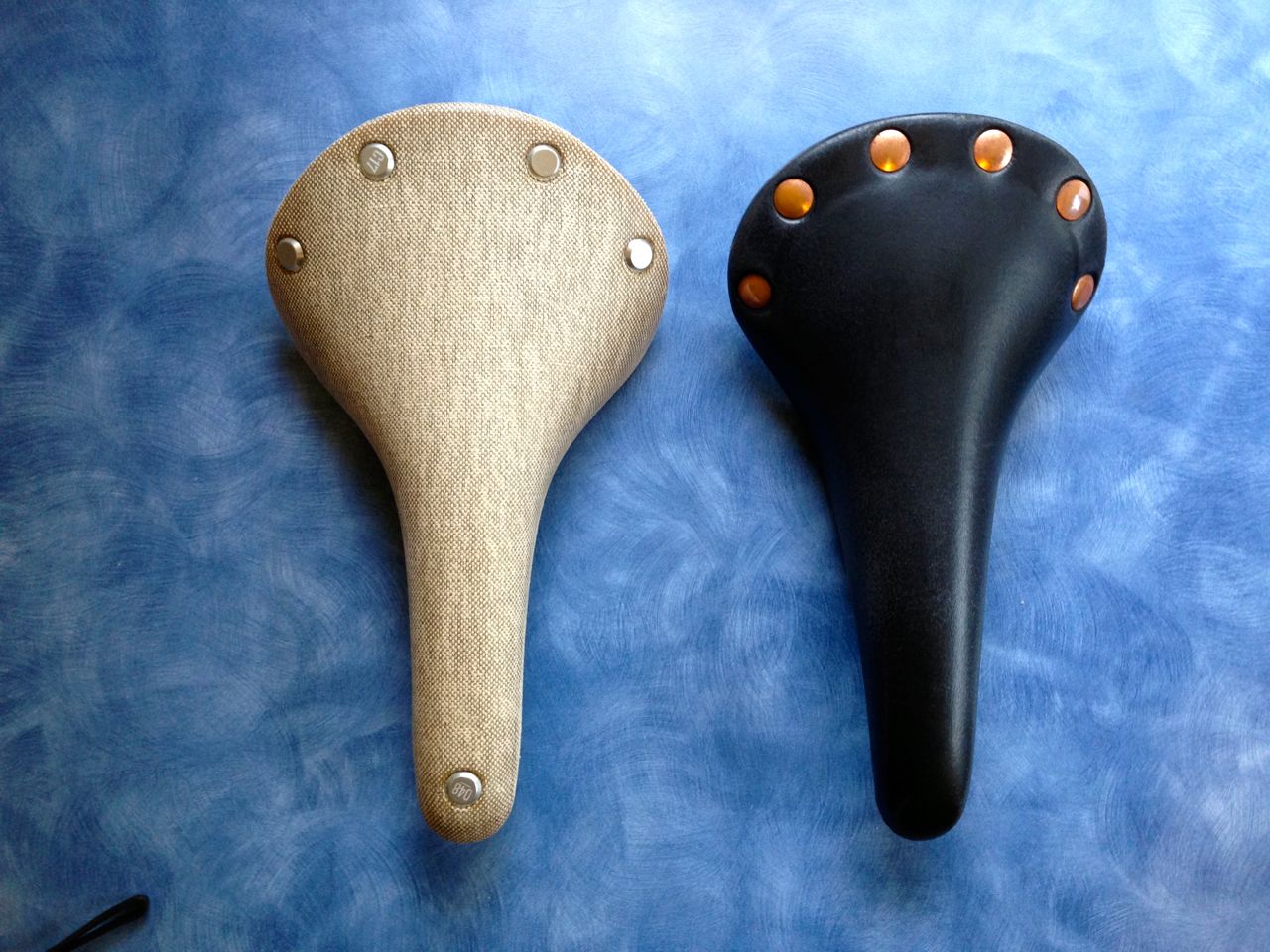
Here it is next to my old beat up B17.


As you can see the size is pretty similar. The B17 is longer, but most of that is because I've stretched it out about an inch from its original length by turning the tensioning screw.

The underside of the C17 is really quite elegant compared to the old B17.


As you can see, the usable part of the rails is much longer than on the B17, so it should be easier to get the saddle into the right fore/aft position without having to resort to seatposts with lots of setback.


Here it is next to my Selle San Marco Regal.


The C17 is a bit wider, but about the same length, and the shape is similar. The Regal is probably my all time favorite non-Brooks saddle, so if the C17 feels a bit like a cross between a Regal and a traditional Brooks saddle, that just might be the saddle of my dreams.


I mounted the Cambium on a bike and went out for a quick spin around the neighborhood this evening. I really don't think any meaningful opinions can be formed about a saddle after sitting on it for a few minutes, so I'll just say that there were no unpleasant surprises.

In my few short years of being a semi-serious cyclist, one of the issues I've struggled with on and off is finding a saddle that's comfortable beyond 300 km. The Brooks Cambium looks promising, but it will probably be a while before I'll know how it works for me in the long run.

Update 29 September 2013: After putting some miles on the C17 I wrote a more complete review here.

Wednesday, July 17, 2013

Evolution of the Budget Randonneuse

I've been into randonneuring for five years now, and in each of those years I've used a different bike as my main brevet bike. I guess you could say I'm a bit of a commitment-phobic serial monogamist when it comes to bikes. With each new bike, I start off the relationship thinking that this bike is "the one." "This is the bike I'm going to grow old with," I'd think as I gazed lovingly at its slender chainstays and gracefully curving fork. But eventually something better comes along.

In 2009 I started randonneuring on a Gunnar Sport which was a light and sporty bike, but turned out to be a little small for me.

In 2010 I had a Surly Cross Check, the original "budget randonneuse." It was a good sturdy, practical bike, but it sort of rode like a tank.

In 2011 I replaced the Surly with a VO Randonneur which was lighter, livelier and more elegant, though it wasn't without its quirks.

In 2012 I rode my 1982 Trek 311 set up as a single speed. The idea was to complete the SR series on the Trek and then go back to riding my VO on brevets. But after riding that old Trek almost exclusively for the first half of 2012, I found that the VO didn't do it for me anymore. It was that humble old Trek that I wanted to continue spending my time with. The Trek fit me better than any bike I've ever owned before. The handling was exactly what I wanted out of a brevet bike. It could handle fenders and wide tires. I liked the way it looked. The only problem was that it was a single speed and I really wanted to keep it that way, but some brevets call for a bike with gears. The obvious solution was to find myself another bike just like my Trek 311, and then set it up with a multispeed drive train. It would be like having my old Trek with a convertible drive train that could flip from single speed to multispeed depending on my mood.

One of the many great things about these old Trek bikes from the 80s is that on any given day you can't swing a dead cat on Seattle Craig's List without hitting two or three of them. It took a few weeks to find the right model in the right size, but eventually I found exactly what I was looking for: a 1982 Trek 614.


The price was right (I don't remember exactly, but it was something under $300), and the condition was near perfect. It still had the original tires with plenty of rubber left so it was obvious it hadn't been ridden more than a few hundred miles in its life. All of the original parts were there right down to the bottle cage and Trek logo water bottle just like in the 1982 catalog picture.


Other than the chainstays being a centimeter longer, the geometry of the Trek 614 is identical to the that of the 311. But better yet, the 614 is built with higher quality tubing throughout, making it a bit lighter than the 311 and giving it a "livelier" ride. The difference in ride quality is surprisingly noticeable. Jumping hard on the pedals of the 614 is like plucking the low E string of a good acoustic guitar. The energy you get back is greater than what you put into it.


I went for a couple rides with the 614 in its original configuration, but as usual, it wasn't long before I tore it apart down to the bare frame and started rebuilding it with my own mongrel assortment of parts.


Some of the parts came from the VO, others are original to the Trek and a couple are brand new acquisitions.


Now days, the drive train is the same crazy mix of Shimano, Campagnolo, Sram and Suntour that worked so well on my Trek 560. None of the parts are exotic or expensive, but they all work together well and make for a very functional and reliable bike that is still easy to ride after a long day or two in the saddle.


I've ridden the 614 on a full super randonneur series this year as well a Flèche. As I had hoped, it has everything I love about that old single speed Trek 311 and more. I was able to set new personal best times on the 200k, 400k and 600k brevets. I can't say for sure that the bike makes me faster, but clearly it's not holding me back.


Will I remain any more faithful to this bike over time than I have been to the others? That's hard to say, as I'm still deep in the honeymoon phase. But for now this old craigslist Trek is the randonneuse of my dreams.


Here are the build details for you gearheads:

Frame/Fork: 1982 Trek 614 (Reynolds 531 main triangle, Ishiwata Magny 10 Manganese stays and fork blades, Ishiwata CCL semi-sloping fork crown, Nikko lugs, Suntour GS forged dropouts)
Headset: Original Trek Micro-adjust
Rear Wheel: Ultegra hub/Mavic Open Pro rim 32 spokes
Front Wheel: Schmitt Son28 hub/Mavic Open Pro, 32 Wheelsmith XL14 spokes
Stem: Original SR Custom Alloy
Handlebars: Original SR Custom Alloy
Brakes: Tektro "standard reach" dual pivot calipers (brake bridge and fork drilled to allow modern recessed nut attachment)
Shifters/Brake Levers: Campagnolo Veloce ErgoPower 10 speed levers
Crankset: Sugino Alpina compact crankset with 48/34 rings
Bottom Bracket: IRD
Front Derailer: SunTour Cyclone Mk II
Rear Derailer: Shimano 105
Cassette: SRAM 8 speed 11-28 PG-850
Tires: Continental Gran Prix 4 Season 700c x 28
Seatpost: VO Grand Cru
Saddle: Brooks B17
Fenders: VO polished aluminum 45mm
Front Rack: VO Rando rack mounted with P clamps
Lighting: Rear: PB Superflash. Front: B&M IQ Cyo mounted on the front rack
Bar tape: Black cork
Pedals: Shimano SPDs
Handlebar bag: VO Campagne
Computer: VDO MC 1.0


Wednesday, July 3, 2013

The High Spark of Low Trail Bikes - Part 2

As all three of my regular readers will have noticed, I took a long break from posting on this blog. I have various reasons (or excuses) for taking the break, but none of them have anything to do with a loss of interest in randonneuring, cycling or anything vaguely bicycle related. I'm still as cycling obsessed as ever, though admittedly a complete neophyte compared to some of my riding partners. Anyway, it's time to jump back into the blog world.

Many months ago, I wrote a post about "low trail" front geometry and my Trek 311. Since then I've completed an SR series on that bike, not to mention countless just-for-fun rides and literally thousands of commuting miles, so I now have a lot more experience with the handling, both with and without front loads. With that additional experience, I thought I'd write some follow-up thoughts on the old Trek 311 and its low trail front end geometry.


But before I say any more I should warn you, I’m a lousy bike reviewer. There’s nothing rigorous or scientific about my reviews. These are just my thoughts on a bike I own, and I find that I almost always like the bikes I own. Even when they are $75 Craig's List finds (which the Trek 311 is). I may not like everything about them, but I usually find something to like because… well, because they’re mine and because in most cases I built them up myself from a bare frame and a bunch of parts. Furthermore, I tend to ride old “junkers,” so what do I know about good bikes, right? I've ridden a few nicer modern bikes here and there, but for the most part I ride bikes that are either old (Treks from the 80s) or new-ish, but using old designs and technology (VO Randonneur). I love combining an old steel frame with a mix of old and new parts to make a bike that is comfortable and highly functional for me. My bikes aren't vintage museum pieces and they aren't state of the art racing machines, they’re just my vision of good, useful and relatively inexpensive bikes. So, if you’re interested in a thorough and objective review of a bike that’s relevant in today’s market place, you may want to go here or here or maybe even here. But if you’re interested in one randonneur’s esoteric equipment choices and what he thinks about them, please read on.

I reread that last post from February and realized that after a lot more riding, my first impressions haven’t changed much at all. Specifically, I find that the 311 has stable, yet responsive handling both with and without a light to moderate front load. Without a load it’s a little quicker to respond to input, but barely. I prefer the handling with some weight on the front. For commuting, I often take the handlebar bag off altogether (so I don’t have to worry about the bag being stolen while the bike’s parked at work), and it’s just a bit twitchier than I like that way. The couple of pounds of tools, tubes and other crap I usually have in the handlebar bag for most rides seem to stabilize the ride just enough so I’m less likely to swerve off course when looking over my shoulder to make a lane change, for instance. Even with heavier loads like the 7 – 8 lbs I typically carry on a long brevet, the steering is still responsive when I need to avoid an obstacle, but extremely easy to ride in a straight line or hold steady through a fast turn. I almost never carry more than a few lbs in my handlebar bag, so I can't say much about how the bike handles a heavy load on the front.

Early on when I started riding the Trek with a front load I noticed it had a slight tendency to shimmy under certain circumstances. I've read a fair amount about shimmy being a common problem with low trail front geometry, and my Trek seems to support that. But to put it in perspective, after nearly six thousand miles I've only experienced shimmy a few times. It seems to happen when: a) the handlebar bag is very heavily loaded, like maybe more than 10 lbs, and b) I'm cold. No, really! If I'm cold and especially if I'm shivering, the frequency of my shivers seem to match the bike's oscillations and together we get into a shiver/shimmy feedback loop. Talk about being in sync with your bike... It's never been so bad that I felt at all out of control, and trying to relax my upper body and pressing a knee against the top tube does a good job of dampening the shimmy. I've read that a roller bearing headset can fix the problem, but honestly it's never bothered me enough to do anything about it. But, if you're the kind of person who gets freaked by any shimmy at all (and I wouldn't blame you if you were) then you may want to steer clear of the old low trail Treks.

In the earlier post, I talked about the Trek having a trail measurement of about 45 mm. While that’s lower than the typical mainstream road bike trail number by 10 mm or so, I should point out that it's not as low as most of the true French constructeur influenced randonneuring bikes that often have trail measurements in the 30s*. So, perhaps it would be more accurate to describe the Trek as "mid-low trail". Whatever you want to call it, the trail of my Trek is considerably less than almost any modern mainstream road bike you can buy.

My Velo Orange Randonneur (which I no longer own) had very similar front-end geometry to the Trek. Both bikes have a head tube angle of 73 degrees. The Trek's fork offset is 55mm, while the VO's is 53mm. That works out to about 2mm more trail for the VO than the Trek. For the metrically impaired, 2mm is about the thickness of a US nickle, or in other words, not much at all. The Trek and VO feel somewhat different on the road, but they both handle well with or without a light to moderate front load. My guess is that the differences in handling characteristics can be attributed more to other differences in geometry (chainstay length being the most significant), and differences in set up (stem length, handlebar width) than to the slight difference in trail.


Speaking of differences in setup, I've experimented a little with handlebars of different widths over the past year and was surprised to find that handlebar width seems to affect handling at least as much if not more than differences in trail. The extra leverage provided by a 44 cm wide handlebar vs. say a 39 cm handlebar makes the steering feel much more responsive. On some bikes that's a good thing, but I find that my Trek 311 feels better with narrower handlebars. It just seems much easier to ride smoothly in a straight line, or to hold a steady line through a turn with the narrower bars.

Conclusion
Yeah, well I'm not sure I have much of a conclusion (I told you I'm not much of a reviewer) other than: I really like the way my Trek 311 handles. So much so, that I bought another similar old Trek with the exact same front-end geometry to replace my VO as my main geared randonneuring bike (more on that in another post). But does the Trek's low-ish trail really make a significant difference in the way the bike handles a front load? It helps, but I don't find the difference to be huge. Overall, I think some of the old steel Treks from the 80s make outstanding randonneuring bikes, but it's much more than just front-end geometry that make these old bikes work so well. Tubing choices, quality of construction, overall geometry and design all contribute to make for a fun, smooth riding, well mannered and high performing bike.

* Here are a few modern production bikes to check out that have true low trail geometry:
  • Boulder Bicycles All-Road and Brevet
  • Ocean Air Cycles Rambler
  • Soma Grand Randonneur
  • Rawland rSogn/Stag and Nordavinden