I'm now down to counting the hours until the start of the Cascade 1240. This Saturday at 6:00am about 80 of us Rando-whackos will set off on a 1240 km tour of Washington. The riders will come from all over North America with a few from Europe and even a couple from Japan. We'll have 93 hours to finish the ride. Seeing as how I've never done a ride longer than 600 km, I have no idea which levels of hell (or heaven) I'm likely to visit along the way.
I've been trying my best to guess at how fast I'll be riding the various sections so I can figure out how much time I'll get for sleeping each night, if any. I think I'll probably average about 15 - 16 hours a day on the bike. If I don't lolly-gag too much at rest stops along the way, that should give me an opportunity to get a decent amount of sleep each night. But there's no telling how fast I'll be moving when my legs turn to clay somewhere during day 2 or 3.
In case you're wondering, 1240 kms translates to about 770 miles. That's pretty close to four times the length of the STP route but with 15 times the climbing. Below you can see the route broken into four sections by day.
Day one - Monroe to Naches - 223 miles.
View Larger Map
Day 2 - Naches to Quincy (with a side trip up Chinook Pass) - 214 miles
View Larger Map
Day 3 - Quincy to Mazama - 180 miles
View Larger Map
Day 4 - Mazama to Monroe - 162 miles
View Larger Map
I've been going back and forth between really excited about this ride, and scared shitless. But the bottom line is that events like this are what got me into Randonneuring. For some sick reason I love heading off on a ride not knowing whether or not I have what it takes to finish it. There's so much to be learned from success and even more to be learned failure. Still, I'm hoping for success. Wish me well.

A cautionary tale of obsession
and bicycling in the pacific northwest
Monday, June 21, 2010


Sunday, June 20, 2010
SIR Four Passes 600k
While life has been getting in the way of blogging lately, I haven't completely let the daily chaos keep me from squeezing in a long ride now and then. For instance, on June 5th and 6th I rode the SiR Four Passes 600k. This is a ride I've heard about and wanted to do for a while. In the typical SiR fashion, the route meandered through some of the most gorgeous parts of the state, on both the west and east sides of the mountains. Also in the typical SiR fashion the route did it's best to avoid any flat easy riding. Most of the time we were riding either up or down a mountain pass.
The ride started in Issaquah and headed up and over the Sammamish plateau on it's way to Sultan. From Sultan we headed east on Highway 2 toward our first big climb up Stevens Pass. From the start until the part where Hwy 2 starts tipping skyward, I rode with a fast group consisting of Brian Ohlemeier, Kole Kantner, Erik Andersen and Allan deCamp. We made great time, and I really enjoy riding with all of these guys. But before this ride had even started I had decided I was going to do this one at my own pace. I wanted to find out if it's possible to do a long tough ride like this without a lot of suffering. So, somewhere around Index, I dropped off the back of the group and found a nice comfortable pace for the long grind up Stevens pass.

For a few short but precious miles the route left noisy Hwy 2 to travel the old Cascade Highway that parallels Hwy 2. The old road is an amazing little stretch of bicycling paradise with no cars and beautiful glimpses of waterfalls. I rode this stretch alone and took my time, smelling the roses along the way. Far too soon, the route dumped me back on Hwy 2 with semis whizzing by.
I was taking my time climbing up Stevens Pass because my stomach was mighty angry. Generally I can get away with eating just about anything, but the mini-mart jalapeno cheddar object that I ate back in Skykomish had crossed a line. At this point in the ride the only people who were ahead of me were the four I had been with at the start, but with my stomach problems I had to slow down so that a couple other riders passed me on the way up the pass.

By the time I got to the summit, my stomach was starting to feel better so I was able to enjoy the trip down the east side of Stevens. It wasn't as fast of a descent as I had hoped for due to a bit of a headwind. I got passed by a couple more riders on the way down in to Leavenworth and spent a little while riding and chatting with Charlie White who I had ridden with briefly on the 400k last month.

Charlie and I pulled into Leavenworth around lunch time to find several other riders at the Subway, wolfing down calories, smearing on sunscreen and getting ready for the next climb up Blewett pass. I took a few minutes to enjoy a sit down lunch, actually sitting at a table rather than on the sidewalk for once.

I headed out from Leavenworth alone and actually looking forward to the climb up Blewett Pass. The weather was beautiful if not bordering on too hot. But as the elevation increased, the temperature decreased and in general it was perfect cycling weather. The climb up Blewett Pass never really gets very steep but it goes on for long time. So I settled into a pleasant pace and just kept grinding away until I reached the summit at around 3:00 pm. Robin Pieper was manning a secret control at the summit and had some of the usual salty and sweet rando snacks not to mention some much needed water.
The ride down Blewett was a fun one, though again a headwind kept the speed down some. The route headed south on Hwy 97 toward Ellensburg. Somewhere along this stretch I joined up with Vincent Muoneke and Geoff Swarts for a few miles. Together we enjoyed the scenery and the rhythm of the ride. Eventually Vincent, Geoff and I caught up to Matt Newlin, Mark Roehrig and Wayne Methner, and the six of us rolled into Ellensberg together looking for some dinner.

After Ellensburg, the route headed south on Canyon road along the ?? river. The sun was beginning to get low in the sky and the bugs were out in force. I consumed enough bugs on that stretch of road to save me a few shot blocks. I rode most of the Canyon road stretch with Matt and Wayne, and eventually we joined up with Mark again and the four of us stuck together all the way through Selah and on up Hwy 12 to the overnight control near Rimrock lake. We rolled in to the overnight just before midnight. There we found wonderful volunteers bearing hot soup and other goodies, and better yet, hot showers and warm beds. We also a few other randonneurs looking very ragged, but happy to be done for the day.

I got up around 5:00am the next morning after a few hours of tossing and turning and unfortunately very little real sleep. As exhausted as I was, the aches and pains that come from 250 miles and two and a half mountain passes made sleep elusive. After some pancakes, I was on the road with Wayne, Matt, and Charlie just before 6:00. Overnight, the weather had definitely taken an ugly turn and it was now raining pretty hard. At the top of White Pass the temperature was in the low 40s and the rain wasn't letting up at all. We all put on all the clothes we had for the screaming cold run down the west side of white pass.

By the time we got to the turn off to Hwy 123 Wayne was so cold he was shaking uncontrollably and was having a hard time controlling his bike. Luckily a couple of SiR volunteers had a control set up with a propane heater and hot drinks. Without them there, we could have been in serious trouble. I was cold, but no where near as cold has Wayne and a couple other riders I saw arriving while we were there.
From the control the route started the climb up to Cayuse Pass. I was happy to be climbing again so I could get warm, but my legs were feeling pretty darn useless by this point in the ride. But somehow I was able to keep turning the cranks up the the summit of Cayuse.

The group I had been with split up on the way up Cayuse, and since it was very cold at the top I didn't stop to wait for them. I wanted to carry some of that warmth generated on the climb with me on the chilly descent. The descent down Cayuse toward Enumclaw was a fun wild ride that went on for a long time. The last time I did this descent was on last year's mountain 600k. That time it was in the middle of the night, my lights were too dim, I hurt everywhere and I was going on two nights with virtually no sleep. This time I felt terrific in comparison and was really able to enjoy the trip down.
I stopped for a quick sandwich in Greenwater and chatted with one of the local boys about the ride. He asked where I started, where I had been and where I was going. When I told him about the route he asked why I didn't just drive it. He had a point.
The rest of the ride from Greenwater was on familiar roads and I was really starting to feel the miles. Every brevet has its stretch where time stands still, and on this ride the temporal distortion was somewhere between Enumclaw and Issaquah (the 'claw and the 'quah).
One feature of this brevet that was either extremely annoying or extremely charming (I still haven't decided) was that it ended with a little victory lap around lake Sammamish. After arriving in Issaquah, about a mile from the finish, you had to do a counter clockwise loop around the lake. I like a bike ride around Lake Sammamish as much as the next guy, but when it comes after about 350 miles it takes on a different flavor. But I did my obligatory victory lap and pulled into the finish at Brad Tilden's house. It was 34 hours and 47 minutes since I had left Brad's house the previous morning. Brad's wife served up a great plate of pasta and tolerated my incoherent ramblings and sweaty wool smells.
So I stuck with my plan to ride at my own pace and really enjoyed the ride as a result. But I also learned that suffering is pretty unavoidable on a 600k ride.
The ride started in Issaquah and headed up and over the Sammamish plateau on it's way to Sultan. From Sultan we headed east on Highway 2 toward our first big climb up Stevens Pass. From the start until the part where Hwy 2 starts tipping skyward, I rode with a fast group consisting of Brian Ohlemeier, Kole Kantner, Erik Andersen and Allan deCamp. We made great time, and I really enjoy riding with all of these guys. But before this ride had even started I had decided I was going to do this one at my own pace. I wanted to find out if it's possible to do a long tough ride like this without a lot of suffering. So, somewhere around Index, I dropped off the back of the group and found a nice comfortable pace for the long grind up Stevens pass.

For a few short but precious miles the route left noisy Hwy 2 to travel the old Cascade Highway that parallels Hwy 2. The old road is an amazing little stretch of bicycling paradise with no cars and beautiful glimpses of waterfalls. I rode this stretch alone and took my time, smelling the roses along the way. Far too soon, the route dumped me back on Hwy 2 with semis whizzing by.
I was taking my time climbing up Stevens Pass because my stomach was mighty angry. Generally I can get away with eating just about anything, but the mini-mart jalapeno cheddar object that I ate back in Skykomish had crossed a line. At this point in the ride the only people who were ahead of me were the four I had been with at the start, but with my stomach problems I had to slow down so that a couple other riders passed me on the way up the pass.

By the time I got to the summit, my stomach was starting to feel better so I was able to enjoy the trip down the east side of Stevens. It wasn't as fast of a descent as I had hoped for due to a bit of a headwind. I got passed by a couple more riders on the way down in to Leavenworth and spent a little while riding and chatting with Charlie White who I had ridden with briefly on the 400k last month.

Charlie and I pulled into Leavenworth around lunch time to find several other riders at the Subway, wolfing down calories, smearing on sunscreen and getting ready for the next climb up Blewett pass. I took a few minutes to enjoy a sit down lunch, actually sitting at a table rather than on the sidewalk for once.

I headed out from Leavenworth alone and actually looking forward to the climb up Blewett Pass. The weather was beautiful if not bordering on too hot. But as the elevation increased, the temperature decreased and in general it was perfect cycling weather. The climb up Blewett Pass never really gets very steep but it goes on for long time. So I settled into a pleasant pace and just kept grinding away until I reached the summit at around 3:00 pm. Robin Pieper was manning a secret control at the summit and had some of the usual salty and sweet rando snacks not to mention some much needed water.
The ride down Blewett was a fun one, though again a headwind kept the speed down some. The route headed south on Hwy 97 toward Ellensburg. Somewhere along this stretch I joined up with Vincent Muoneke and Geoff Swarts for a few miles. Together we enjoyed the scenery and the rhythm of the ride. Eventually Vincent, Geoff and I caught up to Matt Newlin, Mark Roehrig and Wayne Methner, and the six of us rolled into Ellensberg together looking for some dinner.

After Ellensburg, the route headed south on Canyon road along the ?? river. The sun was beginning to get low in the sky and the bugs were out in force. I consumed enough bugs on that stretch of road to save me a few shot blocks. I rode most of the Canyon road stretch with Matt and Wayne, and eventually we joined up with Mark again and the four of us stuck together all the way through Selah and on up Hwy 12 to the overnight control near Rimrock lake. We rolled in to the overnight just before midnight. There we found wonderful volunteers bearing hot soup and other goodies, and better yet, hot showers and warm beds. We also a few other randonneurs looking very ragged, but happy to be done for the day.

I got up around 5:00am the next morning after a few hours of tossing and turning and unfortunately very little real sleep. As exhausted as I was, the aches and pains that come from 250 miles and two and a half mountain passes made sleep elusive. After some pancakes, I was on the road with Wayne, Matt, and Charlie just before 6:00. Overnight, the weather had definitely taken an ugly turn and it was now raining pretty hard. At the top of White Pass the temperature was in the low 40s and the rain wasn't letting up at all. We all put on all the clothes we had for the screaming cold run down the west side of white pass.

By the time we got to the turn off to Hwy 123 Wayne was so cold he was shaking uncontrollably and was having a hard time controlling his bike. Luckily a couple of SiR volunteers had a control set up with a propane heater and hot drinks. Without them there, we could have been in serious trouble. I was cold, but no where near as cold has Wayne and a couple other riders I saw arriving while we were there.
From the control the route started the climb up to Cayuse Pass. I was happy to be climbing again so I could get warm, but my legs were feeling pretty darn useless by this point in the ride. But somehow I was able to keep turning the cranks up the the summit of Cayuse.

The group I had been with split up on the way up Cayuse, and since it was very cold at the top I didn't stop to wait for them. I wanted to carry some of that warmth generated on the climb with me on the chilly descent. The descent down Cayuse toward Enumclaw was a fun wild ride that went on for a long time. The last time I did this descent was on last year's mountain 600k. That time it was in the middle of the night, my lights were too dim, I hurt everywhere and I was going on two nights with virtually no sleep. This time I felt terrific in comparison and was really able to enjoy the trip down.
I stopped for a quick sandwich in Greenwater and chatted with one of the local boys about the ride. He asked where I started, where I had been and where I was going. When I told him about the route he asked why I didn't just drive it. He had a point.
The rest of the ride from Greenwater was on familiar roads and I was really starting to feel the miles. Every brevet has its stretch where time stands still, and on this ride the temporal distortion was somewhere between Enumclaw and Issaquah (the 'claw and the 'quah).
One feature of this brevet that was either extremely annoying or extremely charming (I still haven't decided) was that it ended with a little victory lap around lake Sammamish. After arriving in Issaquah, about a mile from the finish, you had to do a counter clockwise loop around the lake. I like a bike ride around Lake Sammamish as much as the next guy, but when it comes after about 350 miles it takes on a different flavor. But I did my obligatory victory lap and pulled into the finish at Brad Tilden's house. It was 34 hours and 47 minutes since I had left Brad's house the previous morning. Brad's wife served up a great plate of pasta and tolerated my incoherent ramblings and sweaty wool smells.
So I stuck with my plan to ride at my own pace and really enjoyed the ride as a result. But I also learned that suffering is pretty unavoidable on a 600k ride.
Sunday, May 16, 2010
SIR Spring 400k
It seems to me that in the Super Randonneur series of brevets (200k, 300k, 400k, and 600k) the biggest step up in difficulty is from the 300k to the 400k. I'm not sure why exactly. Maybe it's because the 400k is the first distance which requires some night riding for all but the very fastest riders. Or maybe because it's the longest distance most Randonneurs do without a sleep stop. It may be because there's just something magical about 400 kilometers (249 miles) and what it does to your body. Whatever it is, I've now experienced it twice and there's no doubt in my mind that the step from 300k to 400k is like going from walking around the block to running a marathon.
On Saturday SiR held their 2010 Spring series 400k. The course was flat by SiR standards with about 7,000 ft of climbing in the entire route. The weather forecast was excellent, with no rain expected and temps in the 50s and 60s, winds would be light. This is the kind of route and forecast that gets a lot of Randonneurs thinking about setting a personal best time for a 400k.

Leaving Seattle behind on the 6:00am ferry
The ride started in Bremerton at 7:00am, so the 6:00am ferry from Seattle was loaded with dozens of bikes and eager randonneurs. On the way over, a lot of people were talking about the fact that the last ferry from Bremerton to Seattle would be at 11:40pm. If you miss that one, you have to wait until 6:20 the next morning. This fact tossed a little more fuel on the fast ride fire. If you finish the ride in about 16 1/2 hours, you can make that last ferry. If not, you share a hotel room with a half dozen other smelly randonneurs in conditions slightly better than a slave ship. 16 1/2 hours for a 400k is pretty darn fast. But... for quite a few, with good weather and a flat course, it's within reach.

Bikes on the ferry
We congregated at the Starbucks in Bremerton as Joe Llona gave the traditional pre-ride pep talk, and then we headed out a few minutes after 7:00. The route would take us out to the coast at Westport, then south to Raymond via 105, and then back North through rolling hills along 101. It followed back roads up to Potlatch state park on Hood Canal and then back to Bremerton.
Since a lot of people were trying to make good time, the name of the game at the start was to find the right group to ride with. On a long flat ride like this one, traveling with a group is much easier than going it alone. Of course, if you find a group that's too slow you'll miss the ferry, and if you find one that's too fast, you end up getting spit out the back in the middle of nowhere, completely cooked and forced to limp in the rest of the way alone. I chose the latter option.

Struggling to stay on the freight train
A few miles out of Bremerton I settled into a long pace line including Mike McHale and several other big strong oxes. On a course that doesn't have much climbing the big guys are always fast. Allen deCamp was also in this pace line. Allen is a strong rider, but like me is built more for the hills than this flat freight train riding. I think we both knew we were going to get worked.

Allen over my shoulder
As the group worked it's way out toward the coast through Shelton, Montesano, Cosmopolis, I was doing all I could to just stay at the back of the line. One of the golden rules of long distance cycling is to avoid letting your heart rate get into "the red zone." Too much time in the red zone and you're cooked. Recovery takes a long time. As we were approaching Westport, I kept falling off the back of the line and then sprinting like mad to catch up again. Every one of those sprints was bringing me closer to the inevitable crash and burn. Finally about two miles from Westport, I fell off the back and decided to let them go. By this point, it was already too late. I was completely cooked. The paceline had been doing better than 20 mph into a head wind. Now on my own, I could barely manage 15 mph. The group was out of sight within a couple of minutes.

This is what I look like when I'm completely cooked
After sitting for a few minutes in Westport and having a sandwich and some other salt delivery mechanisms, I headed off down the coast toward Raymond by myself. With the change in direction, the winds had become favorable. Still even with a tailwind, I was so wrung out that I could barely do 17mph. The paceline I was with before must have been doing 25 mph through this section. But I was happy to be traveling my own comfortable pace.

I took this lovely picture of the guardrail to prove I made it to the coast
Somewhere on the stretch between Westport and Raymond, Michael Gray, Mark Roerhig, and Peter Rankin caught up with me. I rode with them for a while, but quickly realized that I was still too spent to do anything but ride my own pitiful pace, so I dropped off the back once again.

I rode with Michael, Mark and Peter briefly on the way to Raymond
Then a couple miles outside of Raymond I came upon Allen de Camp beside the road with a flat tire. Allen was in the same condition I had been in about an hour back. He had hung on to the Mike McHale freight train for a while longer than I had managed, but also eventually got chewed up and spit out the back. I figured Allen would be the perfect riding partner since at this point neither of us had any loftier goal than to just finish the ride. Allen and I pedaled together at a pitiful pace into Raymond.
At the convenience store in Raymond we saw Michael, Mark, and Peter just about to head out, and then a few minutes later as we were about ready to get back on the road, another group pulled in made up of Bob Brudvik, Robin Pieper, Jan Acuff, Erik Anderson and Rick (?). We chatted briefly and then Allen and I got on the road figuring the group would catch up to us soon enough.
From Raymond we headed North on hwy 101 up and down hills that all looked exactly the same. It was like ground hog day. Climb for twenty minutes, descend down the back side for a couple minutes, repeat. On about the fourth or fifth hill, the group that we saw back in Raymond caught up to us. Neither Allen nor I were completely recovered yet but we decided to join the group so we could get through the rest of the ride a bit faster. At first it felt like a repeat of the too fast freight train from earlier in the day, but eventually we got our legs back and started enjoying the group thang again.

The group I finished with, near Elma
After Elma, the route headed North on a beautiful back road with gentle rollers which was definitely my favorite part of the ride. With very little traffic, we got into a double paceline and chatted and peddle at a comfortable but still fairly quick pace. The sun was getting low in the sky and the light was beautiful. The highlight of this part of the ride for me was riding by the maximum security prison near Shelton. I've never seen so much razor wire in my life. Not that I've ever really considered a life of crime, but that place is enough to keep you living right. As we rejoined 101 again, it was getting dusky so we turned on lights and rode the last couple miles up to Potlatch State Park on Hood Canal.
Joe Llona was at Potlatch with his son and a nice spread of typical Rando food. A cup of noodles was exactly what I needed and Joe had it. The group relaxed and kicked back for a few minutes as we did the math on what we had remaining. We were about 39 miles from the end, and it was a little after 8:00pm. All we had to do was ride 15 mph to make it back to Bremerton with plenty of time to catch the 11:40 ferry. So we rolled out as the last light was fading away with little pressure and a few easy miles remaining.
The last part of the ride was fun. I love riding in the dark. Somehow the aches and pains of a long ride seem to diminish once the sun sets. Again we were in a double pace line and traffic was light. We chatted and dreamt about greasy, salty meals as the final miles ticked by.

Queuing up for the last ferry back to Seattle
We pulled into the finish at the hotel in Bremerton a little before 11:00pm. We had plenty of time for some pizza and a beer before getting on the 11:40 ferry. I think several of us set personal best times for a 400k on that ride. More importantly, I did some good learning on how hard I can push myself before it all falls apart. And I also learned that I can push myself over the edge, and if I take some time, eat some food, get some fluids in me, I can even recover enough to finish the ride. Yep, another good day on the bike.
On Saturday SiR held their 2010 Spring series 400k. The course was flat by SiR standards with about 7,000 ft of climbing in the entire route. The weather forecast was excellent, with no rain expected and temps in the 50s and 60s, winds would be light. This is the kind of route and forecast that gets a lot of Randonneurs thinking about setting a personal best time for a 400k.

Leaving Seattle behind on the 6:00am ferry
The ride started in Bremerton at 7:00am, so the 6:00am ferry from Seattle was loaded with dozens of bikes and eager randonneurs. On the way over, a lot of people were talking about the fact that the last ferry from Bremerton to Seattle would be at 11:40pm. If you miss that one, you have to wait until 6:20 the next morning. This fact tossed a little more fuel on the fast ride fire. If you finish the ride in about 16 1/2 hours, you can make that last ferry. If not, you share a hotel room with a half dozen other smelly randonneurs in conditions slightly better than a slave ship. 16 1/2 hours for a 400k is pretty darn fast. But... for quite a few, with good weather and a flat course, it's within reach.

Bikes on the ferry
We congregated at the Starbucks in Bremerton as Joe Llona gave the traditional pre-ride pep talk, and then we headed out a few minutes after 7:00. The route would take us out to the coast at Westport, then south to Raymond via 105, and then back North through rolling hills along 101. It followed back roads up to Potlatch state park on Hood Canal and then back to Bremerton.
Since a lot of people were trying to make good time, the name of the game at the start was to find the right group to ride with. On a long flat ride like this one, traveling with a group is much easier than going it alone. Of course, if you find a group that's too slow you'll miss the ferry, and if you find one that's too fast, you end up getting spit out the back in the middle of nowhere, completely cooked and forced to limp in the rest of the way alone. I chose the latter option.

Struggling to stay on the freight train
A few miles out of Bremerton I settled into a long pace line including Mike McHale and several other big strong oxes. On a course that doesn't have much climbing the big guys are always fast. Allen deCamp was also in this pace line. Allen is a strong rider, but like me is built more for the hills than this flat freight train riding. I think we both knew we were going to get worked.

Allen over my shoulder
As the group worked it's way out toward the coast through Shelton, Montesano, Cosmopolis, I was doing all I could to just stay at the back of the line. One of the golden rules of long distance cycling is to avoid letting your heart rate get into "the red zone." Too much time in the red zone and you're cooked. Recovery takes a long time. As we were approaching Westport, I kept falling off the back of the line and then sprinting like mad to catch up again. Every one of those sprints was bringing me closer to the inevitable crash and burn. Finally about two miles from Westport, I fell off the back and decided to let them go. By this point, it was already too late. I was completely cooked. The paceline had been doing better than 20 mph into a head wind. Now on my own, I could barely manage 15 mph. The group was out of sight within a couple of minutes.

This is what I look like when I'm completely cooked
After sitting for a few minutes in Westport and having a sandwich and some other salt delivery mechanisms, I headed off down the coast toward Raymond by myself. With the change in direction, the winds had become favorable. Still even with a tailwind, I was so wrung out that I could barely do 17mph. The paceline I was with before must have been doing 25 mph through this section. But I was happy to be traveling my own comfortable pace.

I took this lovely picture of the guardrail to prove I made it to the coast
Somewhere on the stretch between Westport and Raymond, Michael Gray, Mark Roerhig, and Peter Rankin caught up with me. I rode with them for a while, but quickly realized that I was still too spent to do anything but ride my own pitiful pace, so I dropped off the back once again.

I rode with Michael, Mark and Peter briefly on the way to Raymond
Then a couple miles outside of Raymond I came upon Allen de Camp beside the road with a flat tire. Allen was in the same condition I had been in about an hour back. He had hung on to the Mike McHale freight train for a while longer than I had managed, but also eventually got chewed up and spit out the back. I figured Allen would be the perfect riding partner since at this point neither of us had any loftier goal than to just finish the ride. Allen and I pedaled together at a pitiful pace into Raymond.
At the convenience store in Raymond we saw Michael, Mark, and Peter just about to head out, and then a few minutes later as we were about ready to get back on the road, another group pulled in made up of Bob Brudvik, Robin Pieper, Jan Acuff, Erik Anderson and Rick (?). We chatted briefly and then Allen and I got on the road figuring the group would catch up to us soon enough.
From Raymond we headed North on hwy 101 up and down hills that all looked exactly the same. It was like ground hog day. Climb for twenty minutes, descend down the back side for a couple minutes, repeat. On about the fourth or fifth hill, the group that we saw back in Raymond caught up to us. Neither Allen nor I were completely recovered yet but we decided to join the group so we could get through the rest of the ride a bit faster. At first it felt like a repeat of the too fast freight train from earlier in the day, but eventually we got our legs back and started enjoying the group thang again.

The group I finished with, near Elma
After Elma, the route headed North on a beautiful back road with gentle rollers which was definitely my favorite part of the ride. With very little traffic, we got into a double paceline and chatted and peddle at a comfortable but still fairly quick pace. The sun was getting low in the sky and the light was beautiful. The highlight of this part of the ride for me was riding by the maximum security prison near Shelton. I've never seen so much razor wire in my life. Not that I've ever really considered a life of crime, but that place is enough to keep you living right. As we rejoined 101 again, it was getting dusky so we turned on lights and rode the last couple miles up to Potlatch State Park on Hood Canal.
Joe Llona was at Potlatch with his son and a nice spread of typical Rando food. A cup of noodles was exactly what I needed and Joe had it. The group relaxed and kicked back for a few minutes as we did the math on what we had remaining. We were about 39 miles from the end, and it was a little after 8:00pm. All we had to do was ride 15 mph to make it back to Bremerton with plenty of time to catch the 11:40 ferry. So we rolled out as the last light was fading away with little pressure and a few easy miles remaining.
The last part of the ride was fun. I love riding in the dark. Somehow the aches and pains of a long ride seem to diminish once the sun sets. Again we were in a double pace line and traffic was light. We chatted and dreamt about greasy, salty meals as the final miles ticked by.

Queuing up for the last ferry back to Seattle
We pulled into the finish at the hotel in Bremerton a little before 11:00pm. We had plenty of time for some pizza and a beer before getting on the 11:40 ferry. I think several of us set personal best times for a 400k on that ride. More importantly, I did some good learning on how hard I can push myself before it all falls apart. And I also learned that I can push myself over the edge, and if I take some time, eat some food, get some fluids in me, I can even recover enough to finish the ride. Yep, another good day on the bike.
Wednesday, April 28, 2010
"The Alps"
For the month of April I wasn't able to do any of the organized SiR rides, so to keep my R-12 going I decided to ride a permanent. I picked the toughest route I could find since one of my new year's resolutions was to spend less time on the bike, but to make it count when I do ride. As far as I know, the toughest 200k permanent is #517, The Alps (sort of a presumptuous name for ride the goes through towns like Auburn and Hobart). It packs 10,000 feet of climbing into 200 km, without ever going over 1200 feet above sea level. The route starts in Redmond and meanders around South King County, hitting every good climb it can find. It's a little like a bad action film with a bunch of chases and fights and shoot outs, but not much of a plot to string them together.
My aim was to start at 7:00am at the Whole Foods in Redmond. I got there a bit late so didn't get on the road until about 10 after. A minute or so after getting on the road I realized one of my brakes was rubbing, so I had to stop and adjust it a bit. So, a couple blocks into the ride and it was already 7:15.
The ride follows the west side of Lake Sammamish to Eastgate, climbs up to the top of Summerset, then heads down toward Issaquah, and climbs up Cougar Mtn on "Zoo Hill."

Route Map
In my brief Randonneuring history I've heard many stories about other Randonneurs struggling to make the control cutoff times. Apparently I was just dealt a pretty good genetic hand when it comes to cycling, because it's never been a concern for me at all. I've never even really had to think about it. So it was a bit of a shock on this ride when I was approaching the second control near the top of Zoo Hill and realized I was going to be pretty close to the control cutoff. The combination of the late start, stopping to adjust the brakes, two big climbs already, a couple of minor navigational mistakes, and the control being only a few miles into the ride so I hadn't had much of a chance to build up a buffer all meant I was starting up zoo hill with 30 minutes to make the second control. I assumed the control was at the top of the climb, and the climb up Zoo Hill usually takes me about 20 minutes. But since this was the second of 10 big climbs on a 200k ride, I wasn't heading up the hill as fast as I usually do. If I kept my conservative pace, I realized I'd probably make the top of the hill about three to five minutes before the cutoff. But what if I got a flat tire? What if there was road construction up ahead that held me up for a few minutes? I'd be cutting it very close. For the first time in my Rando career, I was actually worried about making a cutoff. I decided to resist the temptation to pick up the pace, and just hope for the best.
Did I mention that the navigation part of Randonneuring is not one of my greatest strengths? So it turns out that the control is actually only about 2/3rds of the way up the climb, so I got there with several minutes to spare. But still it was by far the closest I've ever been to the cutoff. And you know, it was actually kind of fun having that pressure for a few minutes. Not sure I want to always ride with that kind of pressure, but a little bit of it is fun.
From Cougar Mtn the route continues south toward Auburn, climbing every hill it can find along the way. The Alps is one of those routes that makes you a slave to the route sheet. You rarely ride more than a mile or two without making a turn, and the turns aren't all that obvious. If you aren't paying close attention to your route sheet, you'll get lost for sure. Navigation has never been my strong suit in Randonneuring even on the simpler routes.
And to make matters worse, while studying the route sheet somewhere south of Cougar Mtn I realized that when I printed it, any of the cues that had instructions with more than one line got cut off. All I could see was the bottom line. So an instruction like, "Turn right to stay on 196th. DO NOT continue straight onto Sweeney Rd." Showed on my cue sheet as simply, "straight onto Sweeney Rd." "Hmm, this could cause problems," I thought. Sure enough, I missed a turn or two but figured it out fairly quickly just because I was familiar with some of the roads and knew where I was headed more or less. But eventually I found myself hopelessly off course with no clear idea of where I went wrong or how to get back on course. I scratched my helmet for a couple minutes and then decided to use a life line. I called Sarah and asked for help.
At first I spent a lot of time whining and complaining to her about how lame I was for printing the route sheet without noticing the formatting problem. Then we spent a few minutes trying to figure out where I was. Then she tried to figure out a route to get me to where I needed to be, but that got far too complicated, so I decided I just need to backtrack about four miles to where I went off course. Throughout this conversation I kept thinking this route sheet mess was too complicated and I should just bail on the ride (DNF??). Then she found a copy of the route sheet on my computer and read me all of the instructions that got cut off on my version. I took notes and scribbled all over my copy. All of this took over a half hour or more, and once again I started worrying about whether I would be able to make the next control on time. Luckily I had built up a decent time buffer so it looked like, assuming I could get back on course AND I didn't get lost again, I should be able to make the next control with 15 - 20 minutes to spare.
Well, I did make it to the Green Valley Meat and Minimart with plenty of time to spare. (Note to self: Need to go back there sometime in a car. It's a strange and fascinating store.) After the Meat and Minimart, I had nearly 10 miles of flat riding trough the Green River Valley that gave me a good time buffer for the rest of the ride. I didn't have to worry about cutoff times from there on out.

Elevation Profile
The rest of the ride was far less eventful. I stayed on course and rode up and down hills and just kept turning the cranks. I saw some good riding roads that I had never been on before, like Issaquah - Fall City Rd (the old part after it leaves suburbia), and climbed some great hills I've never climbed before, like Lake Alice Rd with a fairly long stretch of >15% grade.
I was good and tired by the time I finally rolled back into the Whole Foods parking lot in Redmond. The ride took me 11 hours 18 minutes which is by far the longest I've ever taken to finish a 200k. But I figure if I could subtract about an hour for the late start, getting lost, and whining on the phone to Sarah I'd end up with a respectable time.
The Alps is a really nice route, but I definitely am no fan of routes that have cue sheets that are longer than my arm. I'll have to ride it again, now that I know the route, so I can just enjoy the ride and look away from my cue sheet once in a while.
My aim was to start at 7:00am at the Whole Foods in Redmond. I got there a bit late so didn't get on the road until about 10 after. A minute or so after getting on the road I realized one of my brakes was rubbing, so I had to stop and adjust it a bit. So, a couple blocks into the ride and it was already 7:15.
The ride follows the west side of Lake Sammamish to Eastgate, climbs up to the top of Summerset, then heads down toward Issaquah, and climbs up Cougar Mtn on "Zoo Hill."

Route Map
In my brief Randonneuring history I've heard many stories about other Randonneurs struggling to make the control cutoff times. Apparently I was just dealt a pretty good genetic hand when it comes to cycling, because it's never been a concern for me at all. I've never even really had to think about it. So it was a bit of a shock on this ride when I was approaching the second control near the top of Zoo Hill and realized I was going to be pretty close to the control cutoff. The combination of the late start, stopping to adjust the brakes, two big climbs already, a couple of minor navigational mistakes, and the control being only a few miles into the ride so I hadn't had much of a chance to build up a buffer all meant I was starting up zoo hill with 30 minutes to make the second control. I assumed the control was at the top of the climb, and the climb up Zoo Hill usually takes me about 20 minutes. But since this was the second of 10 big climbs on a 200k ride, I wasn't heading up the hill as fast as I usually do. If I kept my conservative pace, I realized I'd probably make the top of the hill about three to five minutes before the cutoff. But what if I got a flat tire? What if there was road construction up ahead that held me up for a few minutes? I'd be cutting it very close. For the first time in my Rando career, I was actually worried about making a cutoff. I decided to resist the temptation to pick up the pace, and just hope for the best.
Did I mention that the navigation part of Randonneuring is not one of my greatest strengths? So it turns out that the control is actually only about 2/3rds of the way up the climb, so I got there with several minutes to spare. But still it was by far the closest I've ever been to the cutoff. And you know, it was actually kind of fun having that pressure for a few minutes. Not sure I want to always ride with that kind of pressure, but a little bit of it is fun.
From Cougar Mtn the route continues south toward Auburn, climbing every hill it can find along the way. The Alps is one of those routes that makes you a slave to the route sheet. You rarely ride more than a mile or two without making a turn, and the turns aren't all that obvious. If you aren't paying close attention to your route sheet, you'll get lost for sure. Navigation has never been my strong suit in Randonneuring even on the simpler routes.
And to make matters worse, while studying the route sheet somewhere south of Cougar Mtn I realized that when I printed it, any of the cues that had instructions with more than one line got cut off. All I could see was the bottom line. So an instruction like, "Turn right to stay on 196th. DO NOT continue straight onto Sweeney Rd." Showed on my cue sheet as simply, "straight onto Sweeney Rd." "Hmm, this could cause problems," I thought. Sure enough, I missed a turn or two but figured it out fairly quickly just because I was familiar with some of the roads and knew where I was headed more or less. But eventually I found myself hopelessly off course with no clear idea of where I went wrong or how to get back on course. I scratched my helmet for a couple minutes and then decided to use a life line. I called Sarah and asked for help.
At first I spent a lot of time whining and complaining to her about how lame I was for printing the route sheet without noticing the formatting problem. Then we spent a few minutes trying to figure out where I was. Then she tried to figure out a route to get me to where I needed to be, but that got far too complicated, so I decided I just need to backtrack about four miles to where I went off course. Throughout this conversation I kept thinking this route sheet mess was too complicated and I should just bail on the ride (DNF??). Then she found a copy of the route sheet on my computer and read me all of the instructions that got cut off on my version. I took notes and scribbled all over my copy. All of this took over a half hour or more, and once again I started worrying about whether I would be able to make the next control on time. Luckily I had built up a decent time buffer so it looked like, assuming I could get back on course AND I didn't get lost again, I should be able to make the next control with 15 - 20 minutes to spare.
Well, I did make it to the Green Valley Meat and Minimart with plenty of time to spare. (Note to self: Need to go back there sometime in a car. It's a strange and fascinating store.) After the Meat and Minimart, I had nearly 10 miles of flat riding trough the Green River Valley that gave me a good time buffer for the rest of the ride. I didn't have to worry about cutoff times from there on out.

Elevation Profile
The rest of the ride was far less eventful. I stayed on course and rode up and down hills and just kept turning the cranks. I saw some good riding roads that I had never been on before, like Issaquah - Fall City Rd (the old part after it leaves suburbia), and climbed some great hills I've never climbed before, like Lake Alice Rd with a fairly long stretch of >15% grade.
I was good and tired by the time I finally rolled back into the Whole Foods parking lot in Redmond. The ride took me 11 hours 18 minutes which is by far the longest I've ever taken to finish a 200k. But I figure if I could subtract about an hour for the late start, getting lost, and whining on the phone to Sarah I'd end up with a respectable time.
The Alps is a really nice route, but I definitely am no fan of routes that have cue sheets that are longer than my arm. I'll have to ride it again, now that I know the route, so I can just enjoy the ride and look away from my cue sheet once in a while.
Sunday, April 4, 2010
300k with the Cyclos Montagnards
This is a late, late post. Sorry. Life has been getting in the way of blogging lately...
Last Saturday I rode the SiR spring 300k. The ride started and ended at University Village, about a mile from our house so I definitely had no excuse for not riding to the ride. Before I get into the actual ride I have to fill you in on some of the back story. A couple weeks before this ride I had agreed to ride this year's SiR Fléche with the Cyclos Montagnards team. Yes, I realize that last sentence was full of words that mean nothing to you if you aren't a card-carrying randonerd.
So what's a fléche you ask? Well, its a randonneuring event that even seasoned Randos find confusing. Basically, a fléche is like a brevet that you ride as a team of 3 - 5 riders. Teams have to cover at least 360 km in 24 hours. Each team chooses their own starting point and route, but all of the teams end in the same place at roughly the same time. The idea is for everyone to converge on some nice place where they can all get together for Sunday brunch after the big ride. The fléche rules are designed to keep teams moving for most of the 24 hours. For example, a team can't stay at any one stop for more than 2 hours.
How about Cyclos Montagnards? Cyclos Montagnards is an organization that exists under the randonneuring "tent" and is all about riding farther and faster than you ordinarily need to or want to as a "normal" randonneur. So given their mission, the Cyclos Montagnards fléche team was definitely out to win the overachiever's award by planning to ride over 600 km in the 24 hour fléche when 360 km would do just fine, thank you very much. So, I was a little surprised they asked me to ride with them because having never ridden 600 km in just 24 hours, I'm not sure I'm even capable of it. But I was flattered that they thought I could do it so I agreed to join the team.
Ok, now back to last weekend's 300 km brevet... All of the members of the CM Fléche team (Ryan Hamilton, Brian Ohlemeier, Jan Heine, Hahn Rossman and I) were supposed to be riding the 300 km, so we decided to ride it as a team just for practice. Jan, the CM team captain, decided we were shooting for an 11 hour finish and he even put together a detailed schedule of when we needed to be at each contrôle along the way and how long we could stay (He gave us a whopping 4 minutes at the "lunch" stop, and a minute or two at the others). We gathered in the dark for the 6:00am start and the team chatted a bit amidst the 80 or so other riders who had turned out for the brevet. Just before 6:00 am the ride organizer, Gary Prinz, said and few words of warning and encouragement and sent off the horde into the cool calm morning.
Immediately the CM team took off like a shot trying to get ahead of all the other riders. I figured we would start fast to get ahead of everyone else, and then eventually settle into a more relaxed pace once we had put some distance between ourselves and the other riders. I figured wrong. the pace never really slowed much for the entire ride. I remember thinking for the first 150 km that there was no way I could maintain such a fast pace for the entire ride. But somehow I kept hanging on and staying with the team despite the voice in my head that kept screaming at me to just sit down beside the road and give my legs a rest.
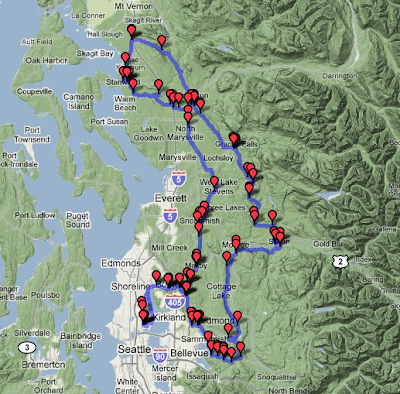
Route Map
The route headed up around the north end of lake Washington and then turned south toward Redmond and Sammamish. After climbing up and over the Sammamish plateau we then had a long flat stretch up through the Snoqualmie Valley heading toward Monroe, Sultan and eventually through Granite Falls to Conway before turning south and working our way back to University village.
 Even though we were still riding faster than my legs thought prudent, the flat ride up through the Snoqualmie Valley was insane fun. With a group of six (Hahn never showed up, but Mike McHale and Eric Anderson hopped on the train with us) we ran a rotating pace line. This was the first time I had ever ridden in a rotating pace line. It's a bit intimidating at first, and a little like being a part in a big, fast machine. It requires some serious concentration, and you never really get to rest like you do in a standard single-file pace line. It's also pretty hard to find enough time for eating and drinking. Other than a few minutes to stop and fix Jan's broken fender, the rotating pace line helped us maintain well over 20 mph average all the way to Sultan.
We made a quick stop in Sultan to get our cards signed and refill water bottles and then started the biggest climbing section of the ride. From Sultan up to Lake Roesiger, the route has some ups and downs (mostly ups), adding up to over 1,000 feet of climbing over a dozen miles or so. One short section on Reiner Road has a pitch of about 18% which definitely gets your attention. During this section I started noticing that my legs were on the verge of cramping every time I stood up and pushed hard. Fortunately for me (not so fortunate for Ryan), Ryan was also fighting cramps about that time, so the group slowed down a bit to let Ryan recover. Nope, not for me, it was all for Ryan (wink, wink). Of course, "slow" for this group was still faster than just about any group I've ridden with before.

Ride Elevation Profile
While we were slowed down a bit I gobbled a couple of Endurolytes (amazing things, those Endurolytes) and caught up a bit on "food" and fluids. Amazingly, I was feeling pretty strong again by the time we rolled into Granite Falls.
The next section rolls along Hwy 9 with ups and downs but nothing steep or long. We were back into our rotating pace line and moving along at a good rate again. We kept this up most of the way to Conway where the course turned South into the teeth of a head wind.
The headwind from Conway wasn't too strong, but it definitely slowed us down. It was tough to work together here because the wind was at an angle forcing us to spread out across the road in order to stay in each other's draft. Needless to say, cagers aren't crazy about a group of cyclists taking up the entire lane on a busy highway.
By the time we got to Arlington, and on to the Centennial Trail, we were mostly out of the wind. Unfortunately I was also mostly "out of wind." Jan, Brian and Mike were still riding strong, so I just sort of hung on to the back and let them do most of the pulling as we flew down the trail. Thanks for the hard work, guys. This isn't the first time I've received a free ride behind Mike. The man is pretty amazing on the flats and into the wind. He always modestly claims it's entirely due to his fancy-schmancy carbon fiber deep section wheels. But it certainly doesn't hurt that his legs can generate about as many watts as a Toyota Prius.
Somewhere between Snohomish and Woodinville, I got a flat tire. I came to a stop and threw my leg over the bike to get off and my leg immediately cramped to the point that I could hardly stand up. While I stood there beside the road screaming in pain and massaging the back of my thigh, Ryan, Brian, Mike and Eric were fixing my flat. Note to self: When riding with nice guys, fake a bad cramp whenever you get a flat. Moan and groan and massage your leg for a few minutes while your buddies fix the flat. When they're done, you just hop back on the bike and say your cramp is much better, thanks, and ride off into the sunset with your hands still clean. By the way, those guys fixed the flat in about half the time it usually takes me.
The last fifteen miles of the ride were on the Burke-Gilman trail. We were all starting to smell the barn at this point, and as a result, were probably riding a bit faster than we should have been given all the Saturday afternoon traffic on the trail. So, I'd like to send an open apology out to all those folks on the trail that we blew by. But, I hope you can all appreciate that a randonneur's judgement can get a bit cloudy when they get within a few miles of the end of a brevet.
We rolled into the finish in U Village at 4:10, 11 hrs 10 min after the start. We didn't make our 11 hour goal, but I'm going to blame my flat tire and Jan's broken fender for that.
This was the third brevet (counting the 100k populaire) of the season, and the third one in which I ended up riding with a fast group of riders. One thing I'm starting to realize about riding with some of the faster riders is that fast rides tend to make for boring ride reports. I spend the entire ride clinging desperately to the back wheel of the rider in front of me so I have no time for taking pictures or watching for interesting sights along the way. Working as a team is a lot of fun, but it's definitely a different kind of fun than when I take a brevet at a more leisurely pace. Both approaches have their pluses, and I probably won't know how I'll approach my next brevet until I get out there.
By the way, a couple of days ago I learned about a work commitment that's going to make it impossible for me to ride the fléche. I'm disappointed, but I have to say, the thought of riding the pace we rode on the 300k for 24 hours straight was a little intimidating. I was doing some serious suffering for about 10 of those 11 hours. No doubt I would have set a new personal best (or worst) for suffering on the fléche.
Last Saturday I rode the SiR spring 300k. The ride started and ended at University Village, about a mile from our house so I definitely had no excuse for not riding to the ride. Before I get into the actual ride I have to fill you in on some of the back story. A couple weeks before this ride I had agreed to ride this year's SiR Fléche with the Cyclos Montagnards team. Yes, I realize that last sentence was full of words that mean nothing to you if you aren't a card-carrying randonerd.
So what's a fléche you ask? Well, its a randonneuring event that even seasoned Randos find confusing. Basically, a fléche is like a brevet that you ride as a team of 3 - 5 riders. Teams have to cover at least 360 km in 24 hours. Each team chooses their own starting point and route, but all of the teams end in the same place at roughly the same time. The idea is for everyone to converge on some nice place where they can all get together for Sunday brunch after the big ride. The fléche rules are designed to keep teams moving for most of the 24 hours. For example, a team can't stay at any one stop for more than 2 hours.
How about Cyclos Montagnards? Cyclos Montagnards is an organization that exists under the randonneuring "tent" and is all about riding farther and faster than you ordinarily need to or want to as a "normal" randonneur. So given their mission, the Cyclos Montagnards fléche team was definitely out to win the overachiever's award by planning to ride over 600 km in the 24 hour fléche when 360 km would do just fine, thank you very much. So, I was a little surprised they asked me to ride with them because having never ridden 600 km in just 24 hours, I'm not sure I'm even capable of it. But I was flattered that they thought I could do it so I agreed to join the team.
Ok, now back to last weekend's 300 km brevet... All of the members of the CM Fléche team (Ryan Hamilton, Brian Ohlemeier, Jan Heine, Hahn Rossman and I) were supposed to be riding the 300 km, so we decided to ride it as a team just for practice. Jan, the CM team captain, decided we were shooting for an 11 hour finish and he even put together a detailed schedule of when we needed to be at each contrôle along the way and how long we could stay (He gave us a whopping 4 minutes at the "lunch" stop, and a minute or two at the others). We gathered in the dark for the 6:00am start and the team chatted a bit amidst the 80 or so other riders who had turned out for the brevet. Just before 6:00 am the ride organizer, Gary Prinz, said and few words of warning and encouragement and sent off the horde into the cool calm morning.
Immediately the CM team took off like a shot trying to get ahead of all the other riders. I figured we would start fast to get ahead of everyone else, and then eventually settle into a more relaxed pace once we had put some distance between ourselves and the other riders. I figured wrong. the pace never really slowed much for the entire ride. I remember thinking for the first 150 km that there was no way I could maintain such a fast pace for the entire ride. But somehow I kept hanging on and staying with the team despite the voice in my head that kept screaming at me to just sit down beside the road and give my legs a rest.

Route Map
The route headed up around the north end of lake Washington and then turned south toward Redmond and Sammamish. After climbing up and over the Sammamish plateau we then had a long flat stretch up through the Snoqualmie Valley heading toward Monroe, Sultan and eventually through Granite Falls to Conway before turning south and working our way back to University village.
 Even though we were still riding faster than my legs thought prudent, the flat ride up through the Snoqualmie Valley was insane fun. With a group of six (Hahn never showed up, but Mike McHale and Eric Anderson hopped on the train with us) we ran a rotating pace line. This was the first time I had ever ridden in a rotating pace line. It's a bit intimidating at first, and a little like being a part in a big, fast machine. It requires some serious concentration, and you never really get to rest like you do in a standard single-file pace line. It's also pretty hard to find enough time for eating and drinking. Other than a few minutes to stop and fix Jan's broken fender, the rotating pace line helped us maintain well over 20 mph average all the way to Sultan.
We made a quick stop in Sultan to get our cards signed and refill water bottles and then started the biggest climbing section of the ride. From Sultan up to Lake Roesiger, the route has some ups and downs (mostly ups), adding up to over 1,000 feet of climbing over a dozen miles or so. One short section on Reiner Road has a pitch of about 18% which definitely gets your attention. During this section I started noticing that my legs were on the verge of cramping every time I stood up and pushed hard. Fortunately for me (not so fortunate for Ryan), Ryan was also fighting cramps about that time, so the group slowed down a bit to let Ryan recover. Nope, not for me, it was all for Ryan (wink, wink). Of course, "slow" for this group was still faster than just about any group I've ridden with before.

Ride Elevation Profile
While we were slowed down a bit I gobbled a couple of Endurolytes (amazing things, those Endurolytes) and caught up a bit on "food" and fluids. Amazingly, I was feeling pretty strong again by the time we rolled into Granite Falls.
The next section rolls along Hwy 9 with ups and downs but nothing steep or long. We were back into our rotating pace line and moving along at a good rate again. We kept this up most of the way to Conway where the course turned South into the teeth of a head wind.
The headwind from Conway wasn't too strong, but it definitely slowed us down. It was tough to work together here because the wind was at an angle forcing us to spread out across the road in order to stay in each other's draft. Needless to say, cagers aren't crazy about a group of cyclists taking up the entire lane on a busy highway.
By the time we got to Arlington, and on to the Centennial Trail, we were mostly out of the wind. Unfortunately I was also mostly "out of wind." Jan, Brian and Mike were still riding strong, so I just sort of hung on to the back and let them do most of the pulling as we flew down the trail. Thanks for the hard work, guys. This isn't the first time I've received a free ride behind Mike. The man is pretty amazing on the flats and into the wind. He always modestly claims it's entirely due to his fancy-schmancy carbon fiber deep section wheels. But it certainly doesn't hurt that his legs can generate about as many watts as a Toyota Prius.
Somewhere between Snohomish and Woodinville, I got a flat tire. I came to a stop and threw my leg over the bike to get off and my leg immediately cramped to the point that I could hardly stand up. While I stood there beside the road screaming in pain and massaging the back of my thigh, Ryan, Brian, Mike and Eric were fixing my flat. Note to self: When riding with nice guys, fake a bad cramp whenever you get a flat. Moan and groan and massage your leg for a few minutes while your buddies fix the flat. When they're done, you just hop back on the bike and say your cramp is much better, thanks, and ride off into the sunset with your hands still clean. By the way, those guys fixed the flat in about half the time it usually takes me.
The last fifteen miles of the ride were on the Burke-Gilman trail. We were all starting to smell the barn at this point, and as a result, were probably riding a bit faster than we should have been given all the Saturday afternoon traffic on the trail. So, I'd like to send an open apology out to all those folks on the trail that we blew by. But, I hope you can all appreciate that a randonneur's judgement can get a bit cloudy when they get within a few miles of the end of a brevet.
We rolled into the finish in U Village at 4:10, 11 hrs 10 min after the start. We didn't make our 11 hour goal, but I'm going to blame my flat tire and Jan's broken fender for that.
This was the third brevet (counting the 100k populaire) of the season, and the third one in which I ended up riding with a fast group of riders. One thing I'm starting to realize about riding with some of the faster riders is that fast rides tend to make for boring ride reports. I spend the entire ride clinging desperately to the back wheel of the rider in front of me so I have no time for taking pictures or watching for interesting sights along the way. Working as a team is a lot of fun, but it's definitely a different kind of fun than when I take a brevet at a more leisurely pace. Both approaches have their pluses, and I probably won't know how I'll approach my next brevet until I get out there.
By the way, a couple of days ago I learned about a work commitment that's going to make it impossible for me to ride the fléche. I'm disappointed, but I have to say, the thought of riding the pace we rode on the 300k for 24 hours straight was a little intimidating. I was doing some serious suffering for about 10 of those 11 hours. No doubt I would have set a new personal best (or worst) for suffering on the fléche.
Subscribe to:
Posts (Atom)